Home thoughts from a stroke volunteer abroad
Claire Angell has been spreading the word to an international audience on harnessing the lived experiences of stroke-affected volunteers
Claire Angell has been spreading the word to an international audience on how harnessing the lived experiences of stroke-affected volunteers can improve the recovery journey for others… as well as help with their own rehabilitation.
Claire had her stroke back in 2014 and has played a major role supporting and informing the work of Bristol After Stroke ever since – as well as a host of other UK health bodies.
She’s has just come back from two days in Stockholm…. fresh from sharing with an international audience what she has contributed – and gained – as a volunteer in the stroke community.
So…what did she learn from the event? How was her message received? Would she do it again?
But, to start things off, tell us: just how did your venture begin, Claire?
“An email from Praveen!” she says. “He’d been approached by The Stroke Alliance for Europe’s (SAFE) European Life After Stroke Forum, who were looking for presenters.
“He thought my volunteering experiences would be of real interest to the delegates.
“To be considered you had to submit a 400-word abstract. I must admit, I was pretty hesitant at first… it sounded really daunting. But we both thought it would be a good experience for me just to put the abstract together.
“So I did! And then they asked me to present…
What did you decide to talk about?
Many people reading this will know of Claire’s involvement with Bristol After Stroke as one of our most enthusiastic volunteers in our groups, events and walking netball as well as serving as a “lived-experience” trustee.
But behind the scenes she has taken part in a huge array of other projects which have impacted upon the lives of stroke-affected people up and down the country.
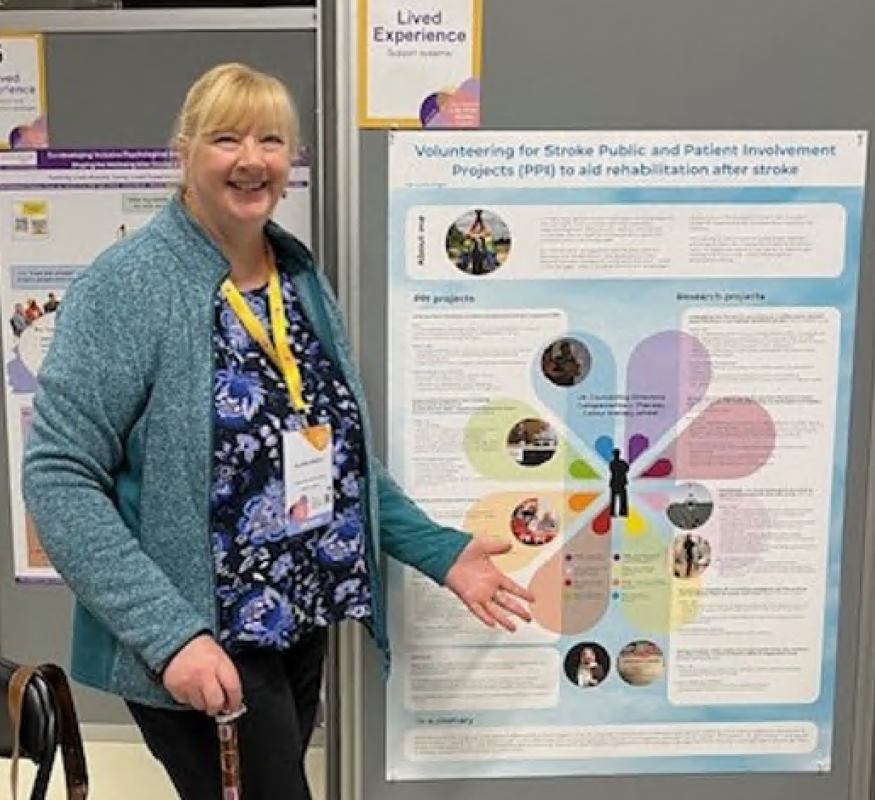
“I found I had a lot to talk about, and I included in my abstract four stroke Patient and Public Involvement (PPI) projects and five research projects. But I could have added as many again.”
How did the volunteering involvement start?
Claire’s very first experience as a volunteer shows just how far she has travelled on her stroke journey since.
“I was asked to talk to a small group of healthcare assistants about what it was like to be the person receiving the care. This was not long after my stroke and, at that point, I was finding it difficult to read and write… and also to talk.
“But I had had some negative experiences during my initial treatment and I really wanted to put the carers in my shoes and let them know how it feels to be the stroke-affected person.
“What I’d found that people kept talking over you when you are in bed, chatting between themselves about their holidays. They weren’t talking to me or even including me in their conversation. I felt like a piece of meat… it was really distressing.
“In short, I cried a lot in that session! But afterwards I felt I had made a difference to how other people might be treated. I also felt better within myself for being able to say those things.
“And that was the start of my being a lived-experience volunteer.”
So, of all those many volunteer roles, which has made the most difference?
“The most meaningful has really been my involvement within the stroke configuration group for over 10 years… and seeing through so many changes in the journey that stroke-affected people experience.
“Promoting the concept of co-design and the involvement of patients in their recovery pathways might seem familiar to us in the SW, and especially so here in Bristol.
“But nationally that has put us well ahead of the game in many ways. And – hearing what other delegates said at the event – we are well ahead of many other countries too.”
And how has being a volunteer helped you?
“Every project I’ve been involved in I’ve learnt and gained from – as well as getting the fulfilment knowing that I am helping others on their pathway.
“It’s played a part in my recovery too.
“You would assume that consultants would be well up to speed on what life is like as a patient, but that’s really not the case. And, as someone not afraid to express my opinions – after all, I’m not paid to do this! – I do feel I’ve made a difference over the years.
“Of course, the fact that I’m a volunteer with Bristol After Stroke has helped too. We offer the benefit of continuity – administrators and consultants may come and go, but volunteers can remain involved and keep making their voices head.”
So how did your presentation go down?
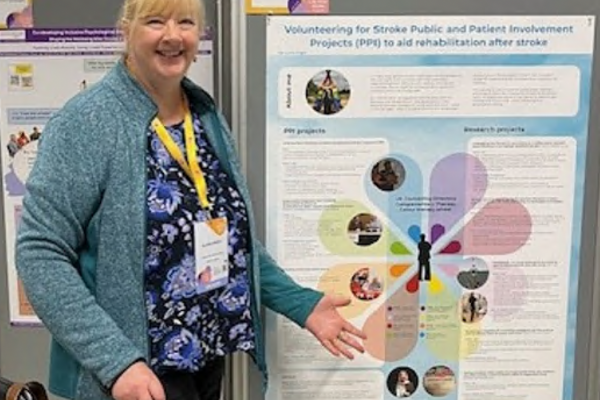
“I had the choice of making an oral presentation or creating a poster which delegates could come and see during all of the conference breaks… and ask questions of me.
“I plumped for the latter!”
The Stroke Alliance for Europe’s Life After Stroke Forum (ELASF) is a very prestigious event: it brings together healthcare professionals, researchers and academics, and policymakers from across Europe to meet, network and advance understanding of life after stroke.
Each year’s programme showcases the latest research, promotes best practices and shares the perspectives of those with lived experience.
Bristol was also represented by Jo White from UWE UK and Akaaba Emmanuel Akino, a stroke survivor, talking about the specific challenges of Black African and Afro-Caribbean communities living with stroke.
“Lots of people came to talk to me, and most – would say – were impressed with just how far advanced we are in Bristol, not least in having so many volunteer-led and co-design activities.
“Yes, it was a big challenge and very tiring, but I do like to set myself new challenges. I got a great feeling of achievement… and I survived!
“Would I do it again? Definitely! I met so many lovely stroke survivors, clinicians, researchers etcetera, all with a common interest to improve the lives of people living with stroke.
“Next year the ELASF will be in Krakow, Poland. If you get the opportunity to go, take it!”


